


People reach for THC for sleep more than for any other night-time reason, and the honest version of what happens is more interesting than the marketing version. Drowsiness sits on Health Canada’s own list of cannabis effects. What a night-side edible actually does to your sleep is a longer answer, and parts of it cut against the easy story.
This covers what THC does once you’re in bed, what a controlled trial measured, how to time an edible so it lands when you want it, and what the packs on our shelf actually say.
What THC does at night
Health Canada lists drowsiness among the immediate effects of cannabis, alongside euphoria, changed thinking, dry mouth and red eyes. That drowsiness is the effect people are chasing.
Most report falling asleep faster and lying awake less. The body-heaviness of an indica-leaning product is the part that reads as sleepiness, and it arrives well before you’re actually tired.
None of that makes it a treatment. We make no medical claims about any product we sell, and anyone using cannabis for a diagnosed sleep problem should be talking to a doctor rather than a delivery service.
The part most articles leave out
A 2025 pilot randomised controlled trial in the Journal of Sleep Research gave people with insomnia a single oral dose of 10mg THC with 200mg CBD, then measured what happened with EEG.
Against placebo, total sleep time went down by about 25 minutes. Time in REM sleep dropped by about 34 minutes. The delay before REM started stretched by roughly 66 minutes.
So the subjective read and the measured read pull apart. People feel like they slept better. The instruments recorded less REM and slightly less total sleep.
Why REM matters
REM is the stage where most dreaming happens, and it does real work on memory and mood. Cutting it has a visible side effect that regular users know well — dreams stop.
They come back with force when you stop. Vivid, exhausting dreams for several nights running is the standard report after a break from night-time use, and it’s REM rebounding.
Timing is the whole skill
An eaten dose is on a slow clock. Onset runs 45 to 90 minutes, peak lands at two to four hours, and the tail runs four to eight.
Take one as you get into bed and it arrives around the time you’d otherwise be asleep. Take it 60 to 90 minutes before bed and the onset meets bedtime instead.
Health Canada puts the outer edge at up to four hours to feel an eaten dose. Redosing before that window closes is the single most common mistake, and it’s how a quiet night turns into an unwanted one.
The morning after
A dose that peaks at 3am leaves you groggy at 7am. If you wake up foggy, the answer is usually an earlier dose or a smaller one rather than a different product.
What the packs actually say
Our clearest night pack states its formula on the front. It’s named Sleep Relax, and the pack lists melatonin, passion flower and CBD alongside 10mg per piece, twenty pieces, wild grape.
Melatonin is the compound your own body uses to signal night. Passion flower is a long-standing herbal ingredient in night blends. Both are printed on the bag, so both are fair to state.
Ten milligrams per piece is the standard dose, which takes the maths off your plate at the end of a long day.
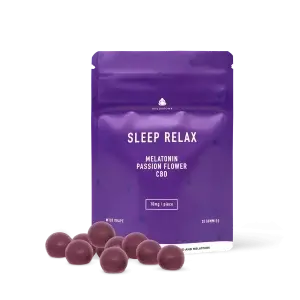
Sleep Gummies - Wild Grape (20 Pack)
Wild grape chews from BuudaBomb’s sleep row: twenty pieces at 10mg each, 200mg per pack. Low per-piece dosing with the number printed on the label.
The Night line
Willo splits its range into Day and Night, and Night is its own shorthand for the heavier, indica-leaning half. The lavender pack sits there — floral and herbal rather than sweet, which suits people worn out by fruit chews.
That bag holds 200mg across ten pieces, so each one carries 20mg. Anything smaller than that is your knife’s decision.

200mg THC Lullaby Lavender (Night) Gummies
Willo’s Lullaby Lavender pack holds 200mg of THC in soft floral chews. Lavender THC gummies for buyers who want the Night formula without another fruit flavour.
Further up the same line, the lychee bag runs 500mg across ten pieces at 50mg each. That’s experienced ground and a poor first edible.
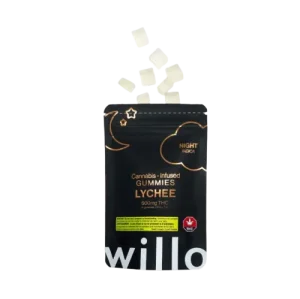
500mg THC Lychee (Night) Gummies
500mg of THC per pack: these lychee THC gummies from Willo pair a delicate floral-sweet flavour with the indica-leaning Night formula. An evening bag for experienced buyers.
The whole Night range sits together, and our gummies shelf covers the rest.
Indica, sativa and the night question
Indica gets sold as the sleepy one and sativa as the daytime one. That split is a rough guide rather than a rule, and it holds often enough to be worth using.
Terpenes sit underneath it — the oils behind smell and taste — plus how much THC the product carries. Two jars both labelled indica land differently, and the label alone won’t tell you which.
The practical move is to treat Night labelling as a starting point and let your own experience overrule it.
Dosing for a night
- 2.5 to 5mg — a starting portion. Plenty for a first attempt.
- 10mg — one standard dose, and what most night packs are built around.
- 20 to 25mg — regular-user territory.
- 50mg — experienced only, and more than most people need for sleep.
Bigger is not sleepier past a point. Overshooting brings a racing heart and anxiety, which is the opposite of the outcome, and Health Canada notes that higher THC raises exactly those odds.
What about CBN?
CBN comes up constantly in sleep conversations. It’s a cannabinoid that forms as THC ages, and the sedation reputation attached to it runs ahead of the evidence — trials are early and small.
Nothing on our shelf is sold as a CBN product, so we won’t claim one. The night packs above work on THC, with melatonin and CBD listed where the pack lists them.
Tolerance, and what happens when you stop
Tolerance builds fast on nightly use. The dose that worked in month one does less in month three, and the usual response is to take more.
A few nights off resets a surprising amount of it. Expect the REM rebound described above, and expect a harder time falling asleep for two or three nights.
Anyone who finds they can’t sleep without it should read that as information rather than a shrug. CAMH covers the dependence side plainly.
A few things that help more than a bigger dose
- Keep the dose time fixed, not the bedtime.
- Eat something small with it — an empty stomach speeds onset and sharpens the edge.
- Skip alcohol. It stacks badly and wrecks the second half of the night on its own.
- Take nights off, so the dose keeps working.
Getting it delivered
We run Toronto in about two hours, noon to 23:00 daily, last call at 23:00 — late enough to cover an evening decision. Orders start at $50 and delivery is free over $70. Interac e-Transfer or cash to the driver, 19+, ID checked.
Browse the Night tag, see where we deliver, or read our other posts on effects.
FAQ
Does THC help you sleep?
Health Canada lists drowsiness among cannabis’s immediate effects, and most users report falling asleep faster. A 2025 controlled trial measured the other side — less REM sleep and slightly less total sleep against placebo. Feeling and measurement disagree here, and we make no medical claims either way.
How long before bed should I take an edible?
Sixty to ninety minutes. Onset runs 45 to 90 minutes and Health Canada puts the outer edge at four hours. Taking one as you climb into bed means it arrives after you’d otherwise have fallen asleep.
How much THC should I take for sleep?
Start at 2.5 to 5mg. Ten milligrams is a standard dose and what most night packs are built around. More is not sleepier past a point — overshooting brings a racing heart and anxiety instead.
Does indica make you sleepy?
Often, and it’s a rough guide rather than a rule. Terpenes and total THC do more of the work than the label does. Treat Night or indica labelling as a starting point and let your own experience settle it.
Is CBN better than THC for sleep?
The research is early and small, and the sedation reputation runs well ahead of it. We stock nothing sold as a CBN product, so we make no claim about one.
Can you take melatonin and THC together?
Our Sleep Relax pack is built that way — the bag lists melatonin, passion flower and CBD next to 10mg per piece. That’s the pack’s own labelling. Anyone on prescription medication should ask a pharmacist first.
Why do my dreams stop, then come back?
THC cuts time spent in REM sleep, the stage where most dreaming happens — about 34 minutes less in that 2025 trial. Stop using it and REM rebounds, which is why several nights of vivid, tiring dreams follow a break.
Why am I groggy the next morning?
The dose peaked too late. Effects run four to eight hours from an edible, so one taken at midnight is still working at breakfast. Move the dose earlier or make it smaller.
References
- Health Canada — Health effects of cannabis
- Health Canada — Consumer information: cannabis
- Acute effects of oral cannabinoids on sleep and high-density EEG in insomnia: a pilot randomised controlled trial, Journal of Sleep Research (2025)
- Cannabis use in patients with insomnia and sleep disorders: retrospective chart review
- CAMH — Cannabis